16% off
Blue Myco
Mushroom Fruiting Bags — Double Patch 0.5 Micron, 23.5"x10"x5.5", Qty 500
32.0 lb
$334.99$399.00Unit price /Unavailable
 Sold out15% off
Blue Myco
XL Mushroom Bags — 0.5 Micron, 24"x10"x5.5", Qty 500 (XLS-A)
47.0 lb
$289.99$339.99Unit price /Unavailable-
7% off
Blue Myco
Mushroom Spawn Bags — 0.22 Micron, 19"x8"x5", Qty 800
18.0 lb
$349.99$375.00Unit price /Unavailable -
Blue Myco
Mushroom Fruiting Bags — Double Patch 0.5 Micron, Qty 50
0.5 lb
$38.99Unit price /Unavailable -
14% off
Blue Myco
XL Mushroom Spawn Bags — 0.22 Micron, 24"x10"x5.5", Qty 500 (XLS-T)
47.0 lb
$284.99$329.99Unit price /Unavailable
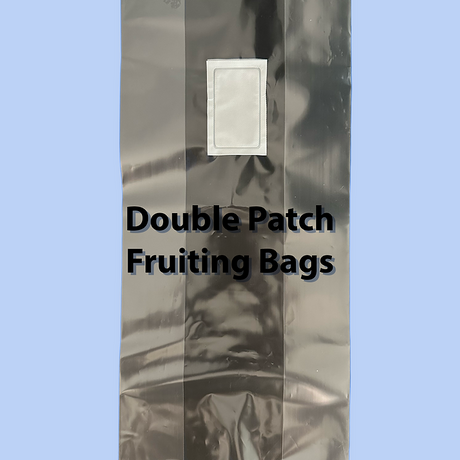


Which bag do you need?
Two things decide it: what stage you're running, and how much volume goes in each bag.
| Bag | Filter | Size | Qty | Best for |
|---|---|---|---|---|
| Spawn bags | 0.22 micron, single patch | 19" × 8" × 5" | 800 | Standard grain spawn production |
| XL spawn bags | 0.22 micron, single patch | 24" × 10" × 5.5" | 500 | Larger grain loads, fewer bags per run |
| Fruiting bags | 0.5 micron, double patch | 23.5" × 10" × 5.5" | 500 | Fruiting blocks, maximum air exchange |
| Fruiting bags, small pack | 0.5 micron, double patch | 23.5" × 10" × 5.5" | 50 | Small grows and trial runs |
| XL bags | 0.5 micron, single patch | 24" × 10" × 5.5" | 500 | Large fruiting blocks and bulk substrate |
0.22 or 0.5 micron?
The filter patch is a tradeoff between air flow and filtration, and the right side of that tradeoff depends entirely on what the bag is doing.
0.22 micron — grain spawn
A grain bag sits sealed for weeks while mycelium works through it, and during that time the only thing between your grain and the room is the patch. The finer pore size gives contaminants less to work with. Air still passes, just more slowly — which is fine, because colonizing grain isn't demanding much gas exchange.
0.5 micron — fruiting
Fruiting is a different problem. Pins and developing fruits need real fresh air exchange, and CO₂ build-up inside a block shows up directly in your yield as leggy stems and small caps. The larger pore size moves substantially more air. Our double-patch fruiting bags go further by placing two patches adjacent to each other to encourage cross flow rather than relying on a single window.
The short version: 0.22 for grain, 0.5 for fruiting. If you only stock one, think about which stage you run more of — most farms go through far more spawn bags than fruiting bags.
Why 3 mil matters
Bag thickness is the specification people skip, and it's the one that shows up as unexplained contamination weeks later.
Thin bags develop micro-tears — from handling, from the pressure and thermal shock of a sterilization cycle, from stacking in a chamber. The tears are usually too small to see. What you notice is a contamination rate you can't trace to anything in your process, because the breach happened inside the autoclave before the bag ever reached your lab.
Every bag we sell is 3 mil polypropylene, gusseted, and rated to come through a full sterilization cycle intact.
Loading bags into a sterilizer
How you pack the chamber matters as much as the bag itself:
- Lay bags in a crisscross lattice — bottom layer running one direction, next layer the opposite
- Leave gaps between rows so steam can circulate through the middle of the load
- Fill the vessel no more than halfway, so bags don't shift during the cycle and steam can move freely
- Stacking bags flush against each other creates cold pockets that never reach sterilization temperature, even when the chamber gauge reads correctly
If you're loading a B-550L or B-1180L, our perforated steam-flow trays hold bags level on a rigid deck with steam passing vertically through it, which gets more bags in per cycle without creating those pockets.
Common questions
Can these bags go in an autoclave?
Yes. All of our bags are 3 mil polypropylene and built to come through a full sterilization cycle intact. Load them in a crisscross lattice with gaps between rows, and don't fill the chamber more than halfway.
Can I use 0.5 micron bags for grain spawn?
You can, but 0.22 micron is the better choice. Grain sits sealed for weeks with the patch as its only barrier, and the finer pore size gives contaminants less opportunity. The extra air flow a 0.5 patch provides isn't doing much for you during grain colonization anyway.
What does the double patch actually do?
Two filter patches placed adjacent to each other encourage air to flow across the bag rather than in and out of a single window. That cross flow gives noticeably better fresh air exchange than one patch of the same total area, which matters most during fruiting when CO₂ build-up costs you yield.
Why does 3 mil thickness matter?
Thinner bags develop micro-tears during handling and sterilization that are usually too small to see. The result is contamination you can't trace to anything in your process, because the breach happened inside the autoclave. 3 mil polypropylene substantially reduces that risk.
Do you offer bulk or wholesale pricing?
Our bags are already sold by the case — 500 or 800 per box depending on the size. If you're running volume beyond that, get in touch with your quantities and we'll quote it.
What's the difference between the XL bags and the standard size?
The XL bags measure 24" × 10" × 5.5" against 19" × 8" × 5" for the standard spawn bag. More volume per bag means fewer bags to fill, sterilize and handle for the same total output — worth it at production scale, less so for smaller grows.